

TRADITIONAL OKINAWAN KARATE IN EDMONTON
International Okinawan Shōrin-ryū Seibukan Karate-dō Association (IOSSKA)
国際沖縄少林流聖武館空手道協会

人に優しく己に厳しくそういう精神が厳しい稽古の中で培うものである。
This spirit of being kind to others and being strict with oneself is cultivated through rigorous training.
Shimabukuro Zenpō, Kaichō IOSSKA.
NEWS

The excellent women of our dojo at this morning's class, ages 12 to 60.

Our member Jared visited the Seibukan dojo in Munich.
Thank you very much, Sensei Bachhuber and the members of Budo Akademie München for taking care of him. He was fortunate to train with such excellent karateka.

We were happy to welcome Raynell and Nathan to their first class.

The dojo is structured by the relationship of sempai (senior) to kōhai (junior), of mutual but different kinds of obligations and respect.

After practise, when you are pouring with sweat and blood, you practise sitting still.
To be able to empty the mind, like a clear space. Not falling asleep. Like a clear space, empty of hopes, ambitions, fears, and worries.
Trevor Leggett

Seniors of the dojo.
In these profoundly evil times, I am proud and grateful to be associated with such very good people.

Karate-dō means "the way of the empty hand." That distinguishes it from fighting arts with weapons, but the emptiness of karate is more than that.
Training requires we free ourselves of the preconceptions and prejudices which impede us. The emptiness of our karate means an emptying out of racism, misogyny, homophobia, transphobia, Islamophobia, antisemitism, and other bigotries.
We're a small dojo, but we're a diverse one. Our members come in different colors, different sizes, different ages, different sexualities, different gender-identifications, different cultural backgrounds, different religious faiths, different forms of families.
New students are large and small, young and old, athletic and unathletic, strong and not-so-strong, supple and inflexible, confident and full of doubts. All are welcomed.
Each of us arrives with our own weaknesses and demons. That's what we work on. We don't care what kind of body you have when you come to us; we don't care what insecurities you bring with you. All we care about is that you show up, make the effort, and be open to the traditions and training of the dojo.
All we expect—and demand—is that you show acceptance, respect, kindness, and support to every other person disciplined and brave enough to step onto the floor beside you. All we ask is that you empty yourself of what's holding you back.

Kenkyo 謙虚 is often translated as "humility," but perhaps a more evocative meaning is "silent competence."
True ability is recognized quietly, much like a master artisan whose work speaks for itself.
This is the opposite of bragging on social media about achievements, awards, or martial arts promotions.

Karate-dō, like life, which it mirrors, is a struggle: a struggle with our own weakness, with our egos and selfishness, with our narrow-mindedness and prejudices.
Nakamura Tadashi 中村 忠

The photo is a dozen years old, but the karate maxim still holds:
空手は心なり。 Karate wa kokoro nari。
Karate is the heart.

Jared, one of our brown belts, atop Table Mountain in Cape Town, South Africa.

Sadō, the way of tea, is traditionally done in a hut whose only door is so small that you need to get down on your hands and knees to enter.
The way of tea is only open to those willing to humble themselves.
Good karate-dō is exactly the same. Our dojo believes that holds no less for a good life.

Two ways of living with yourself
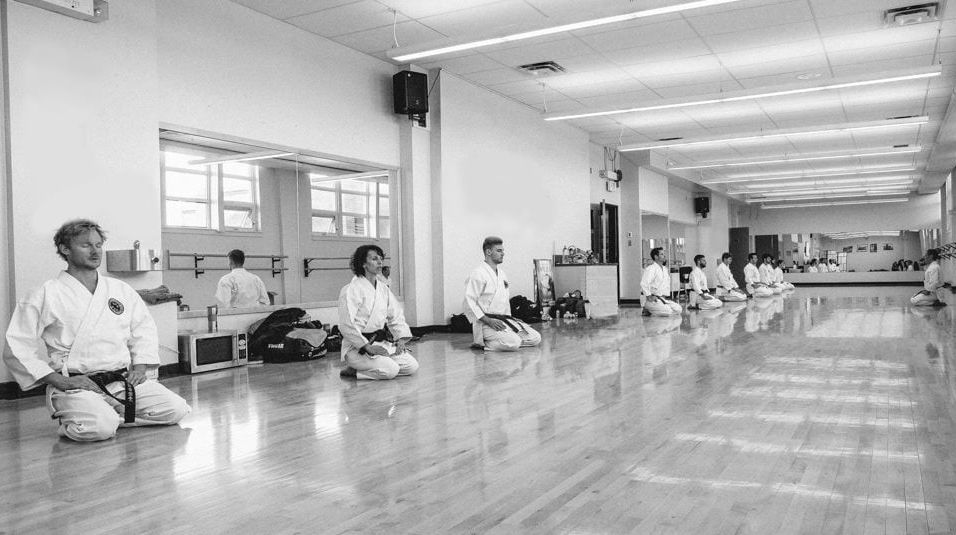
The dojo is austere, a humble place of natural and quiet dignity. Always cleanliness and order predominate. Inasmuch as the dojo links the spiritual and physical elements of karate-dō, the basis of its construction must not conflict with that relationship.
Sabi and wabi—naturalness, simplicity, rusticity (but not without an element of design)—are its keynotes. It follows that the dojo must contain nothing ostentatious to distract the mind, for not only would this run contrary to the element of spirituality in the dojo, but it is patent that no really serious training can be pursued in a training area that contains all sorts of ornamentation.
Adapted from Donn F Draeger

Lucy and Murphy studying the Seibukan book.

We are proud to have these formidable sensei wearing our dojo gear.
Chris Denwood, Whitehaven, UK.
Paul Wilson, Kelowna, BC.
Steve Vinden, Okotoks, Alberta.
John Chioco, Laurel, Mississippi.

I teach dentō (traditional) Okinawan karate. One of the lessons it and Zenpō Sensei have, in turn, taught me is that traditional values are openness, generosity, kindness, and respect. Homophobia, racism, transphobia, misogyny, and religious intolerance are not traditional values; they are just old hatreds.

Craig and Clayton at the Karate Day demonstration in Naha on 26 October 2025. They radiate the rigor and discipline of Seibukan. I am very proud of how they represented the dojo in Okinawa.


Clayton, Jared, Genna, and Craig with Zenpō Sensei and Zenshun Sensei at the Seibukan hombu (headquarters) dojo in Chatan, Okinawa.
I am proud that all of them made the effort to get there. We believe it's essential for our seniors to train with the best Seibukan sensei in the world, not as a once-in-a-lifetime experience, but as regularly as possible, so they can bring back what they learned to elevate the karate of our dojo.
Clayton, Craig, and Jared at hombu dojo in Okinawa.

Genna training at hombu dojo.

The spirit of our dojo: Craig and Genna after participating in the Karate Day demonstrations in Naha, Okinawa on 26 October 2025.

Seibukan karateka on Karate Day 2025, Naha Okinawa.
Our dojo members are beside and behind Zenpō Sensei, who is in the center, wearing a cap.

It's always a happy occasion when a student comes to their first class. Here, Martin gets one-on-one tutelage from Lucy.
Welcome to the dojo, Martin!

The Seibukan banner that hangs in our home, signed by Zenpō Sensei, Zenshun Sensei, and Zenei Sensei.
Training in Okinawa

Lucy and Doug with Zenpō Sensei and Zenei Sensei, May 2025.
We go to Okinawa regularly because Zenpō Sensei is unequivocal that it is necessary:
Karate is from Okinawa, so you must go back to Okinawa and see what we do; every karate technique you must correct in Okinawa. Make sure you visit your sensei and feel all Okinawan people.
Please visit Okinawa, to feel traditional Okinawan karate, and eat Okinawan food and breathe Okinawan air. Many things you have to experience in Okinawa.
Our dojo funds instructors and senior students to travel to Okinawa to learn from the finest Seibukan sensei in the world. In October 2024 three went there, as the Canadian representatives at the 62nd anniversary celebration of Seibukan. Craig stayed for two weeks; Lucy and Doug were there for a month. It was demanding, illuminating, and marvellous.
Lucy and Doug returned to Okinawa for three weeks in May. They will be going again for a month this coming March. It will be their ninth trip since 2014, despite not going for four years because of the COVID pandemic. They will be joined by three other members of dojo who will be taking their first trip there. Three other dojo seniors went in October. It was Clayton's fourth trip, Craig's second, and Jared's first. They later joined by Genna later in the month.
Our members get to Okinawa often, because we think it's essential. Our purpose is to be a bridge between the karate and culture of Okinawa and good people in Canada seeking to move with more grace through life.

Araha Beach, where we stay in Okinawa.

In what's become a happy tradition, we had lunch with Sensei at a Chinese restaurant. We loved the conversation over good food, as Sensei reflected on karate, Okinawa, and his life.

When we were in Okinawa, Zenpō Sensei told us he would never change kata. Our dojo will always follow his example; we will, to the best of our abilities, be faithful to the tradition that has been passed down to us.

Our last training session this trip was at the Urasoe Dojo this very wet morning. Kyan-san gave us this beautiful sampler that she wove herself. Weaving is a traditional Okinawan art form.
We get treated so well here by such good people. Lucy and I are going to miss them so much as we head home. "Ichariba chodee": "Once we meet, we become family."
Our Edmonton Dojo

9000 km from Okinawa, we are doing our best to uphold the great tradition of Seibukan karate-dō.

